Understanding Loan Loss Provisioning for SACCOs
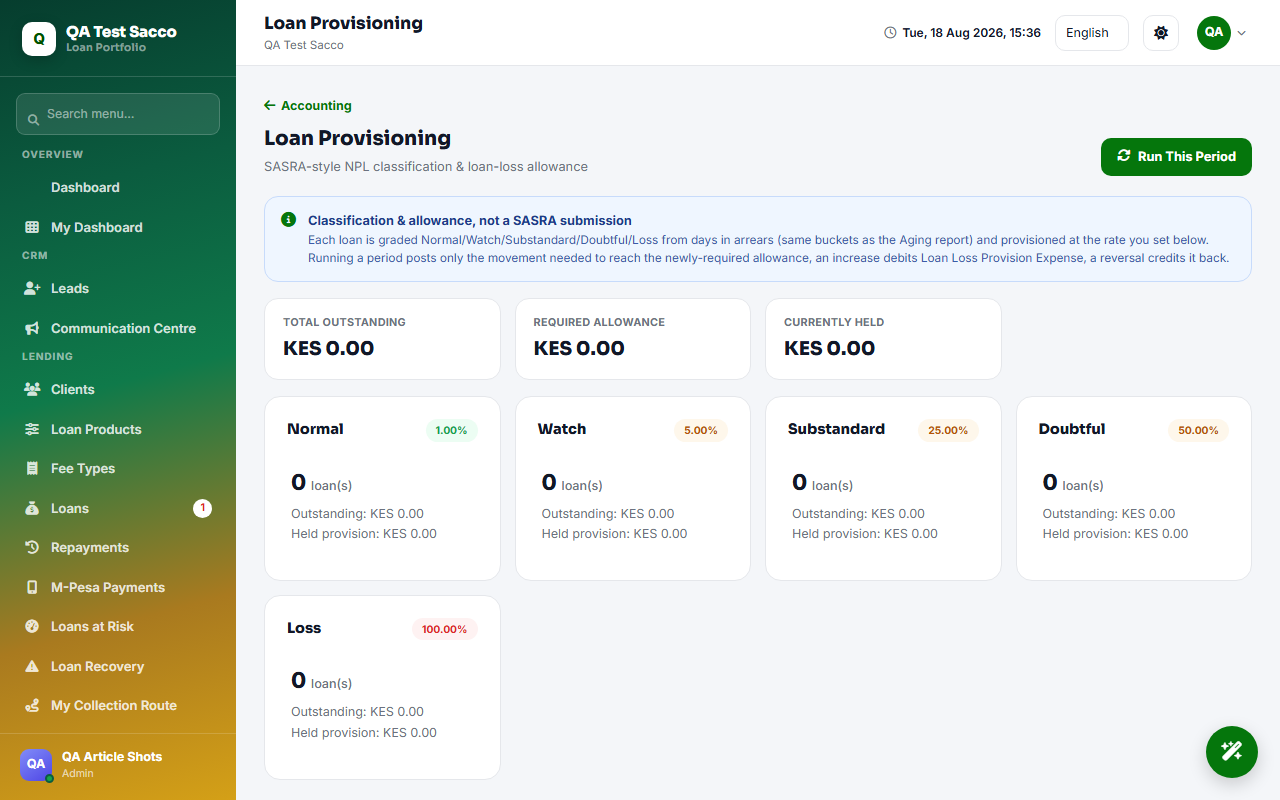
Every lender, including every SACCO, will eventually have some loans that don't get repaid on schedule, and a portion of those will never be recovered in full. Loan loss provisioning is the accounting practice of recognising that reality ahead of time, setting aside a portion of expected losses as a provision, rather than waiting until a loan is formally written off to acknowledge the loss.
The starting point is classifying loans by how overdue they are, current, then increasingly severe categories as arrears age, commonly grouped into buckets like 1 to 30 days, 31 to 90 days, and beyond 90 days, with a loan generally considered non-performing (an NPL) once it crosses a set threshold, often 90 days past due. Each bucket carries a different assumed probability of eventual loss, a loan 10 days overdue is statistically far more likely to be repaid than one 200 days overdue, and the provisioning rate applied to each bucket should reflect that.
The provision itself is a real accounting entry, an expense recognised now against the SACCO's income, and a contra-asset reducing the loan book's carrying value, not just a note on a spreadsheet. That matters because it directly affects the SACCO's reported financial position, a SACCO that doesn't provision properly can look more profitable and more solvent on paper than it actually is, which is exactly the kind of gap that causes real damage when it's discovered at audit time or, worse, when members try to withdraw and the money genuinely isn't there.
Getting this right requires two things working together: an accurate, automatically updated ageing of every loan in the book (not a monthly manual review that's already stale by the time it's finished), and a provisioning policy applied consistently rather than judged loan by loan on a case-by-case basis.
pawa Loans tracks arrears ageing on every loan automatically and applies configurable provisioning rates per bucket, posting the resulting provision through the same real ledger as every other transaction, so a SACCO's reported financial position reflects its actual loan book risk, not an optimistic guess.
Frequently asked questions
When is a loan considered non-performing?
Commonly once it crosses 90 days past due, though the exact threshold and bucket structure (e.g. 1-30, 31-90, 90+ days) is set by the SACCO's provisioning policy.
Is a provision just a note on a spreadsheet?
No, it's a real accounting entry: an expense recognised now, and a contra-asset reducing the loan book's carrying value.
What happens if a SACCO doesn't provision properly?
It can look more profitable and solvent on paper than it actually is, a gap that usually surfaces at audit time or, worse, when members try to withdraw and the money isn't there.
Ready to run your SACCO, chama, or microfinance from one dashboard?
Get started